Here from the video? Welcome. Part 1 is lesson 1 on this site. Run the two-sensor fusion yourself →
Every sensor is a little wrong. The Kalman filter combines them into one good estimate. Learn it by running Python on every page.
4 short lessons · Python in your browser, nothing to install · A robot with GPS, a rocket to Mars, a robot tracked by two radars · 14-day money-back guarantee
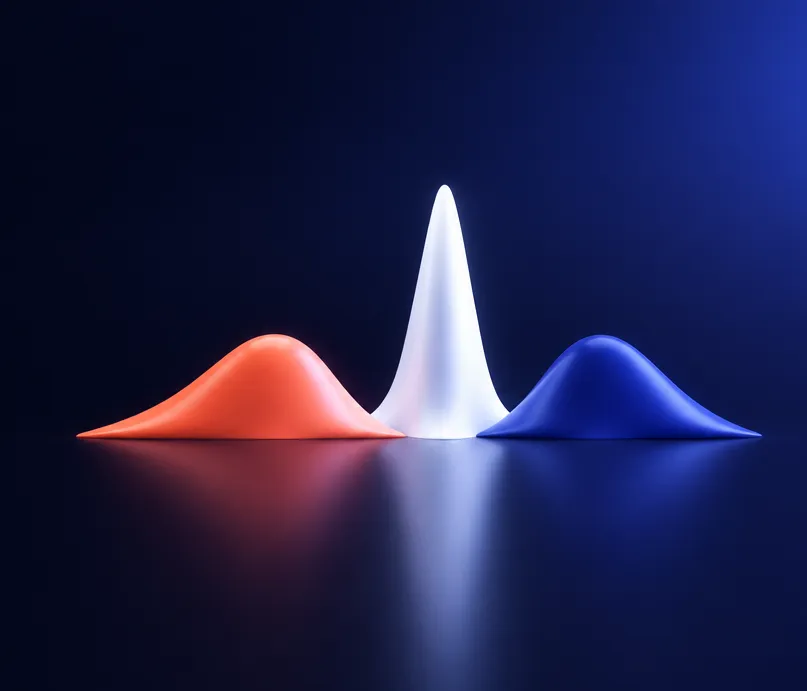
 Lesson 1Noise and data fusion6 slides with live Python.Start lesson →Chapter 1 · Noise and fusion
Why no sensor tells the truth, how the Gaussian describes its noise, and how to fuse two noisy readings into one better estimate.
Free Lesson 2The 1D Kalman filter6 slides with live Python.Start lesson →Chapter 2 · Filtering in one dimension
A robot on a line with an encoder and a GPS: why each one fails alone, and how predict and correct combine them into the Kalman filter.
Free preview Lesson 3The matrix Kalman filter7 slides with live Python.Start lesson →Chapter 3 · Many variables at once
Many variables at once: correlation and the covariance matrix, how uncertainty moves through a model, state space, and the full matrix filter on a rocket.
Free preview Lesson 4The extended Kalman filter6 slides with live Python.Start lesson →Chapter 4 · Nonlinear sensors
When the sensor is not linear: zoom in until the curve looks straight, use the Jacobian, and track a robot from distance-only radars.
Steppe lives inside every lesson. It knows which lesson you are on, the code and the common mistakes, and answers in seconds, day or night.
Example answer. Steppe can make mistakes; the lesson has the final word.
Every slide explains one idea with an everyday picture first: two thermometers, a robot on a line, a rocket on its way to Mars. Then comes the maths, a worked example with real numbers, and where it shows up in drones, robots and phones.
Next to the text is a lab. The Python runs in your browser, nothing to install. Functions like plot(...), gauss(...), cov(P) and track(...) draw time plots, bell curves, covariance ellipses and 2D maps. Each slide ends with a small exercise that checks your answer.